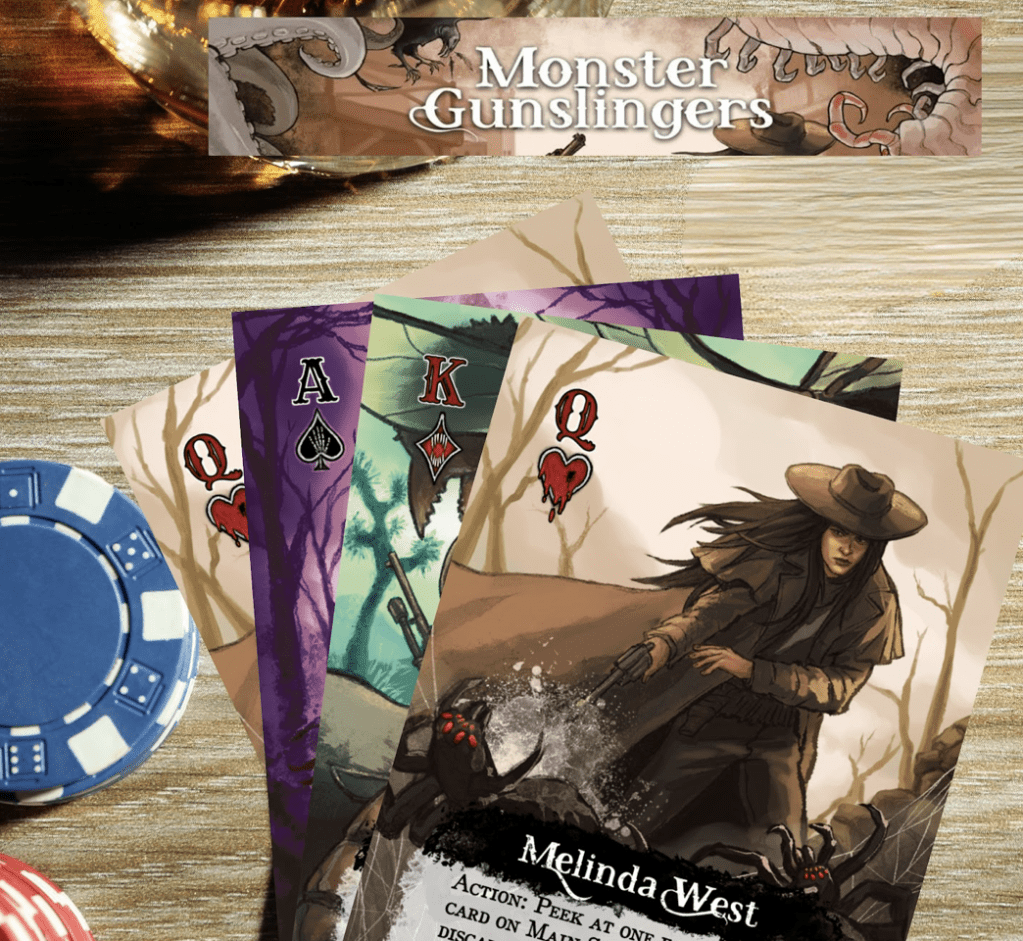
Monster Gunslingers The Game® is a labor of love, a partnership between streamlined game design by J. Liu and creative storytelling by KC Grifant.
The card characters are based on the award-winning Melinda West: Monster Gunslinger universe created by KC Grifant, where a stoic gunslinger and cast of characters fight monsters in an alternative version of the Old West.
The game design is inspired by decades of Liu’s competitive card and board gaming, and a desire to develop a fun party game that can be picked up and played easily. Read Liu’s full Game Design Diary of Monster Gunslingers below.
Game Design Diary for Monster Gunslingers
By J. Liu, Designer
October 1, 2025
The year is 2004 and I am in the basement of Your Move Games (YMG) in Boston, and I am either playing Magic: The Gathering (MTG), Lord of the Rings TCG, Legend of the Five Rings, or HeroClix miniatures. During this period, I bounce around and play a variety of tabletop games and miniatures.
The game store has recently installed flat screen TV sets, on which we casually watched ESPN between taking turns, specifically the World Series Texas Hold’em poker event. This was the kind of reality TV I could get into, a real “mental sport” as Richard Garfield championed for MTG to become one day. Several of us gamer friends make plans to host and play poker late into the evenings at one of our apartments since the game store closes at 10pm. This is the sort of thing we end up doing regularly, since sleep doesn’t matter all that much in your 20s.
At that point in my life, I really didn’t have a lot of disposable income and any that I did have went toward saving up for plane tickets to see family or attend events like GenCon. Many friends and acquaintances invited me to house poker tournaments to play Texas Hold’em, which I had often turned down due to “other plans” when in fact I was just too poor to justify a measly $20 buy-in for a night of fun.
Times where there were buy-ins for $5 I joined, and more often than not we ended up waiting up an hour for everyone to show up. The combination of wanting to play Texas Hold’em poker without having to gamble with cash I didn’t have and wanting a game to play with my friends while we waited for others to arrive got me thinking about a board game with a poker theme.
The dream was to play games for a living and I believe that was a big appeal for many of us competitive gamers to start watching poker on TV. So naturally, my original concept was a game that had a board that kind of resembled Candyland, where you travel around Las Vegas and had to play in mini poker tournaments at each casino to qualify for the World Series and win the most amount of chips.
I started to research more about games during this period, specifically boardgames and a variety of CCGs and TCGs that used poker mechanics. The two that immediately jumped out at me was Deadlands: Doomtown and Bang! Luckily, I had a friend named Chea Willis who was into dead CCGs and actively bought CCGs on clearance from local game stores including all the Doomtown packs. He showed me how to play Doomtown, difficult of a game it was, I was instantly hooked and taken at how much strategy it had.
I also liked how flavorfully Doomtown tied in a whole world to match the game mechanics. Players travel around a town with chess-like precision, controlling and playing deeds as resources, and going into shootouts using poker mechanics while sculpting the perfect hand to beat opponents. I quickly pivoted my game concept from a World Series of Poker theme to a wild west theme inspired by Doomtown but with different mechanics and without the steampunk elements.
Having tried Raw Deal CCG and being a fan of Back to the Future, I wanted the cards to be memorable to play. Not surprisingly, being someone in their early 20s, I made the cards to be yelling insults. Over the years I’ve lost the large posterboard mat with green felt and some of the random game pieces, but I was able to locate a mostly intact deck of cards. See below.
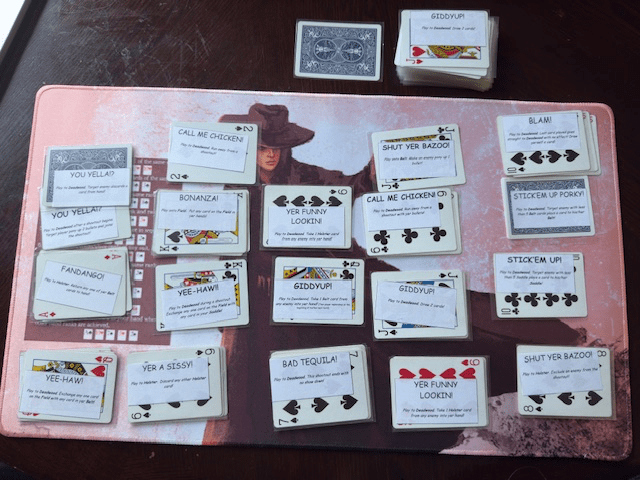
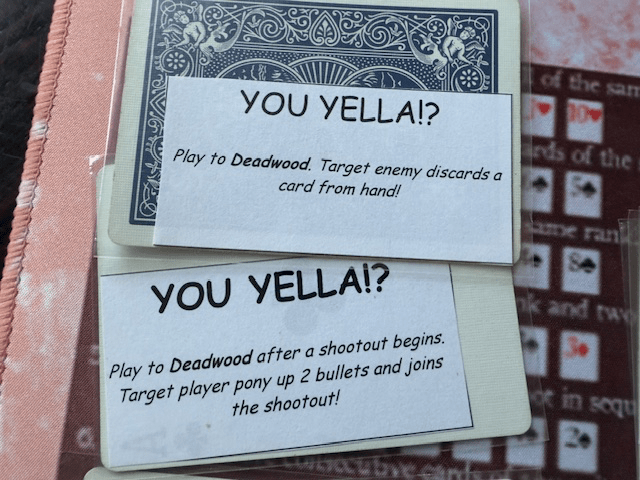
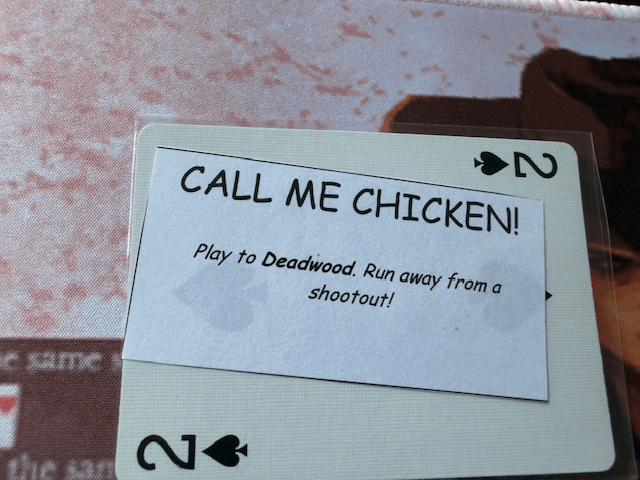
It has been a long time and since then, I’ve lost my original game board, notes, and pieces over the years and many apartment moves. I vaguely recall the shootouts were meant to be multiplayer, the discard pile was referred to as deadwood (inspired from the HBO show), the field was the community cards, bullets were chips, the belt was an area on the board, and the holster was the two-hole cards each player could have.
Being a longtime gamer doesn’t necessarily translate to being a good game designer and, at that age, I didn’t have the proper discipline nor attention span to give the game what it needed. Over the course of a year I play tested off and on and it had a lot of problems and challenges. I was also pulled in many different directions with both game design and in life, so I actively had to make a decision about what I was doing in my free time.
For a long time, the game sat in a box on the shelf above the winter coats in a closet and would move from apartment to apartment in Boston with me, and eventually into a pod when I relocated to San Diego in my 30s.
Sometime around 2016, we unpacked our storage pods to settle into our new home here in San Diego. As we unpacked, my wife KC dusted off a brown box and looked inside to see random chips and bicycle cards with penny sleeves and paper slipped inside and asked me what this was. After telling her about the game, she asked if this was kind of like Doomtown Reloaded.
Rewind: before we moved into our house and while we were renting an apartment in San Diego, Doomtown was relaunched as a Living Card Game (LCG). Since I was already a huge fan of the original CCG but never got to play the game during the time it was alive, I knew I had to get into Doomtown Reloaded as I wasn’t going to miss this chance again. KC, being the amazing and wonderful partner that she is, might’ve been reluctant to dip her toes into her first competitive card game but she went along with it. We had been playing Doomtown Reloaded together for a year at this point and we were enjoying it very much.
Fast forward: KC suggested that I revisit and complete the game. She was very encouraging, as she reminded me that it has been over a decade and I’ve evolved and had a ton of more gaming experience.
Taking everything I have learned about good game play, game development, and business costs, I knew the size and game pieces would dictate how much we had to invest if we self-published the game. I decided to strip all the thematic fluff. I also trimmed the game mat, board game pieces, and poker chips and condensed everything to just a deck of cards. Over the span of the next couple of years I was the random guy who would bring a prototype game to a Super Bowl party, birthday party, or just about anywhere I thought there was a chance people would want to sit down and play some cards to get them to help play test my game.
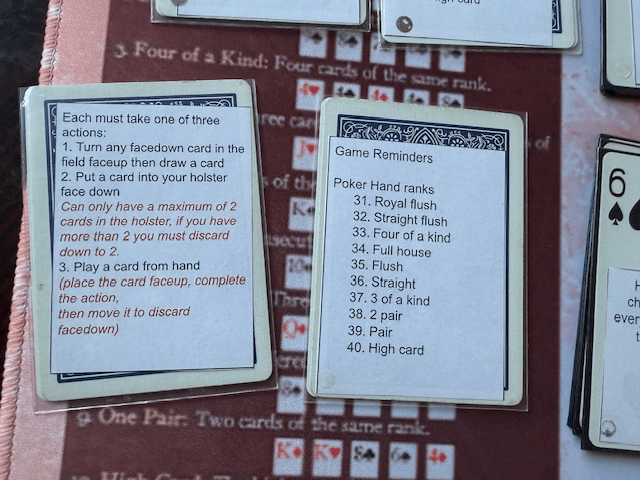
Initially, the game was intended to be 3-4 players, so I created 4 copies of a reference card and each card had on one side poker hand ranks for anyone who has never played poker or who might just need a reminder of hand strengths. On the other side were the 3 different possible actions that each player must take each turn and that was really all the game required.
I had yet to flush out how many cards each player started with, so this varied a lot early on, but this was close to the final stages of where the game is today. Along the way, if I found a mistake I would handwrite the changes on paper and when I got around to it, I would type it up and print out and cut new slips to insert into the sleeves. (Advice to any aspiring game designers: take a lot of notes digitally and don’t lose track.) As trivial as an idea might be, it may turn out to be very useful later. I often had ideas but would later forget the details and regretted not writing them down.
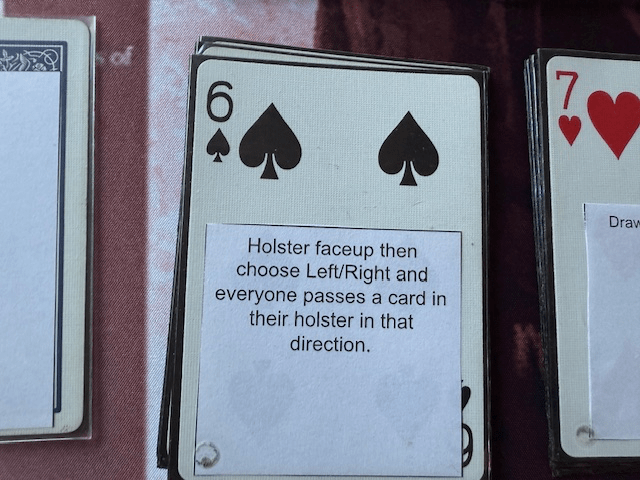
Take note of the 6: play into the holster and then choose left or right and everyone passes a holster card in that direction. I still like this card design except it would behave mechanically so differently from a 2-player game versus a multiplayer game. Although I like this original 6 design I do like the new 6 where you holster and get information about someone else’s holster card even more.
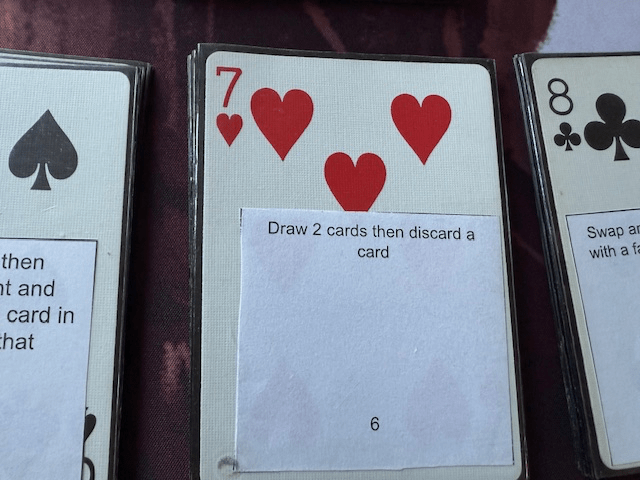
To this day I am still debating about changing the 7 and the 3 as having to discard a card can awkwardly change the game play pace as some players will inevitably debate and take longer to decide on what card to discard. I think game pace is an important aspect to consider as I don’t want folks to get bored and start scrolling their phones while they wait.
Over the years from 2016 up until 2020 the gameplay was mostly the same with a few minor tweaks here and there. It wasn’t until KC suggested that I should stop tinkering with the game and finally publish it. I felt like there was something missing but I couldn’t put my finger on it, until I realized games do well with story and “fluff” as part of the fun. This is where things came full circle. Due to my and KC’s involvement with Doomtown and KC having written official short stories for Doomtown, she eventually went on to become a very successful weird west fiction author, with her Monster Gunslinger book series becoming published. She suggested we combine forces and use her original story and characters as the backdrop for my game.
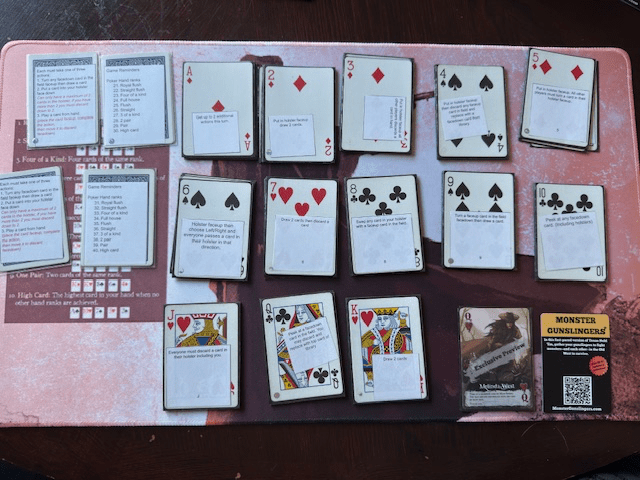
Once we decided to use the backdrop of the Melinda West: Monster Gunslinger universe as part of the game, KC and I put our heads together and started analyzing each card to determine how to best merge the game and story together.
We came to the decision to use characters as the central element for all the cards and have any monsters, places or items as secondary. This is to follow the storyline that the players are gathering their posses in town to fight an onslaught of monsters (and each other) to survive. However, there may be potential for expansions for Monster Gunslingers in the future that could add these components more centrally. I already have some ideas.
After determining which characters best aligned with each of the card actions, I did make a few minor tweaks to the cards, such as adding the ability to draw a card at the end of the Queen for Melinda West since she is the main character of the story. I always wanted the Queen to be powerful, but during playtesting often losing a card for information wasn’t enough to use over just holstering the high card. The added ability of drawing a card to replace herself sends her nearly to the top as my favorite card and is, in my opinion, the most powerful card.
With the characters aligned with the cards, we now had to search for artists and art direction to determine the look and feel for the game. This is where KC primarily took over, with me providing input. We had to consider whether we wanted the art style to be more anime-like, cartoony, realistic or macabre. KC talked with many freelancers but we found a talented and wonderful collaborator in Canadian artist Jenny Chin, who was quick, adaptable and enjoyed the “Weird West” aesthetic as much as we did.
Without going into all the minutiae of bringing a game to fruition, we completed the game and actively researched how to best begin manufacturing, including printing, boxing and shipping a final product. The amount of work and decisions to make to complete this last phase was overwhelming to the point where we stalled, wondering what the best approach would be. Eventually a good friend of ours, Jon Cohn, who is a successful game designer himself and the author of Slashtag and many other excellent horror books, played our game and suggested we consider pitching our game to a publisher, licensing or selling the game outright. After putting in so much work already we knew we wanted to stay closely involved with the game, and this is when we were introduced by Jon to Nate Murray at Red23 Publishing, who has been a wonderful partner throughout this process. Nate has been instrumental in providing feedback that has made the game better–such as changing the 6 as mentioned earlier, adding the advanced rules of betting, and cementing the idea that a Joker is necessary to close in the skill gap.
Now, as we get ready to bring the game to market, we are grateful to everyone who has playtested and helped along the way. With Red23 as our partner, the finish line is at last in sight for a 2026 launch. I’m proud and excited for this next chapter when players beyond our immediate circle can sit down, open the box and enjoy the game on their own.
Addendum: Jokers
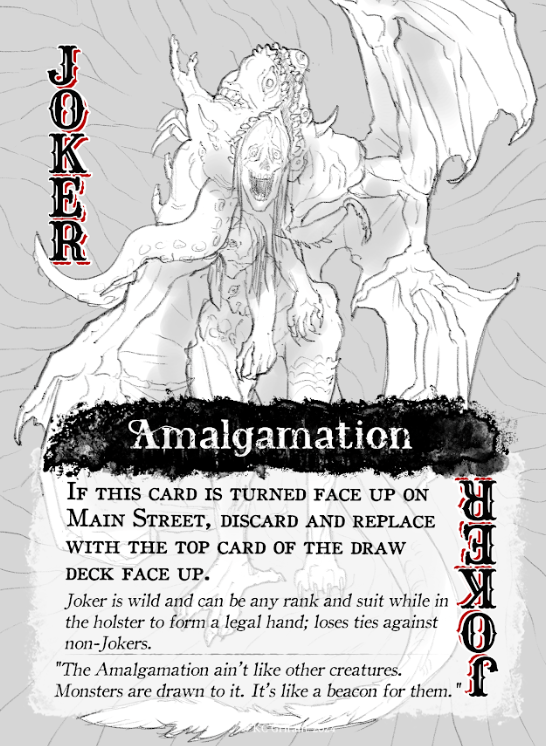
This card was added at the tail end after the game was completed. Although I have had the idea of adding Jokers in my notes with a number of different abilities, I never settled on anything or was serious about having Jokers in the game. But when Nate and I talked, we believed that the game strongly favors players who are analytically strong gamers or players familiar with poker, so I set out to design Jokers that could either be added or left out of the game based on whomever was playing. So if you want a more skilltested game leave out the Jokers, but if you are playing Monster Gunslingers and want more chaos, then add them!
One of the early Joker abilities I was tinkering with was a one-time action to discard your entire holster to draw 5 cards. I do want to create other Jokers with various different abilities where players could optionally choose which Jokers they want to use for Monster Gunslingers (similar to how the popular mobile game of Balatro has many different kinds of Jokers). Upon completing the Joker design, KC and I decided that the Joker would be a great way to showcase the “Big Bad” of the town, so we named it the Amalgamation. This will be a new monster introduced into the world of Melinda West and KC is writing a brand new dedicated story just for the game.
Game Tips
Although the game was designed to play 2-6, I believe the best experience is with 3-4 players. The game could technically play up to 8 or 9 players if the starting hand is reduced and the first couple of turns the action to reveal a card on Main Street is not taken. There is a small risk with that many that some players may never get a turn if players decide to actively start revealing Main Street.
If you haven’t fallen asleep from this detailed overview of the game development, here are some tips if you want to up your game in Monster Gunslingers. You actively want to take actions that will net you additional cards or see more cards, so information is key. Once you know 2 or more cards on Main Street, you will want to sculpt your hand of cards that best positions you to win. As one example, get an 8 or 4 into your hand to protect yourself from someone ending the round if you need more time to build your hand. I designed the game so that facedown cards on Main Street are generally protected other than from the Queen, Melinda West herself. So if there is a face up card you want to protect on Main Street, the 9 is a great way to protect it.
There are many strategies but the last one I will leave you with is if there is a card you want to protect in your holster, such as a Joker, than make sure you play it as your 2nd holster card instead of the 1st to avoid Tsen, the dreaded Jack that makes everyone discard a card in their holster.
Thank you for reading this and stay tuned for the game launch! I hope you join me on this exciting adventure of my first completed game!
 Monster Gunslingers The Game®